

Weather is an essential part of our daily conversations. Whether you’re discussing the rainy season, planning a trip, or just making small talk, knowing weather-related vocabulary in different languages can be extremely useful. In this blog, we will explore common weather terms in English, French, German, Spanish, and Italian, helping you expand your multilingual skills.
At Lingua Lab, we believe that learning a new language is not just about grammar and sentence structure but also about understanding practical vocabulary that you can use in real-life situations. Let’s explore these essential weather words and see how they translate into four major European languages!
Basic Weather Terms in Multiple Languages
1. General Weather Conditions
• Sunny → French: Ensoleillé | German: Sonnig | Spanish: Soleado | Italian: Soleggiato
• Cloudy → French: Nuageux | German: Bewölkt | Spanish: Nublado | Italian: Nuvoloso
• Windy → French: Venteux | German: Windig | Spanish: Ventoso | Italian: Ventoso
• Rainy → French: Pluvieux | German: Regnerisch | Spanish: Lluvioso | Italian: Piovoso
• Snowy → French: Neigeux | German: Schneebedeckt | Spanish: Nevado | Italian: Nevoso
2. Extreme Weather Conditions
• Storm → French: Orage | German: Sturm | Spanish: Tormenta | Italian: Tempesta
• Hailstorm → French: Tempête de grêle | German: Hagelsturm | Spanish: Granizada | Italian: Grandinata
• Thunderstorm → French: Orage avec tonnerre | German: Gewitter | Spanish: Tormenta eléctrica | Italian: Temporale
• Hurricane → French: Ouragan | German: Hurrikan | Spanish: Huracán | Italian: Uragano
• Tornado → French: Tornade | German: Tornado | Spanish: Tornado | Italian: Tornado
• Cyclone → French: Cyclone | German: Zyklon | Spanish: Ciclón | Italian: Ciclone
3. Other Common Weather Terms
• Drought → French: Sécheresse | German: Dürre | Spanish: Sequía | Italian: Siccità
• Flood → French: Inondation | German: Überschwemmung | Spanish: Inundación | Italian: Alluvione
• Fog → French: Brouillard | German: Nebel | Spanish: Niebla | Italian: Nebbia
• Drizzle → French: Bruine | German: Nieselregen | Spanish: Llovizna | Italian: Pioggerella
• Frost → French: Gel | German: Frost | Spanish: Escarcha | Italian: Gelo
• Blizzard → French: Blizzard | German: Schneesturm | Spanish: Tormenta de nieve | Italian: Bufera di neve
Why Learn Weather Vocabulary?
1. Everyday Conversations
Weather is a universal topic in daily conversations. Whether you’re speaking with a native speaker or just making small talk while traveling, discussing the weather is always a great icebreaker.
2. Travel and Safety
Knowing weather terms can be extremely useful when traveling. Imagine you’re in France, Germany, Spain, or Italy, and you need to check the weather forecast or understand emergency announcements regarding storms, heatwaves, or snowfall.
3. Improving Language Skills
Expanding your vocabulary beyond basic greetings and phrases can boost your fluency and make you sound more natural in your target language. Weather terms are practical and easy to incorporate into conversations.
How Lingua Lab Helps You Improve Your Vocabulary
At Lingua Lab, we provide structured language training that helps you expand your vocabulary in multiple languages, including French, German, Spanish, and Italian.
Our Unique Learning Approach:
✅ Practical Vocabulary Lists – We focus on real-life vocabulary, like weather, travel, and daily life topics.
✅ Interactive Exercises – Practice through quizzes, fill-in-the-blank tests, and flashcards.
✅ Speaking & Listening Practice – Improve pronunciation with audio lessons and speaking activities.
✅ Personalized Lessons – Our courses are tailored to suit different learning levels, from beginners to advanced learners.
If you want to enhance your multilingual skills and become fluent in discussing weather and other everyday topics, join Lingua Lab today!
Exercise: Fill in the Blanks
Now, let’s test your knowledge! Fill in the blanks with the correct French, German, Spanish, or Italian word from the vocabulary list above.
1. A __________ (storm) is coming tonight. (French: _________)
2. The temperature is very low, and there is __________ (frost) outside. (German: _________)
3. The weather is very __________ (cloudy) today. (Spanish: _________)
4. The __________ (hurricane) caused a lot of damage. (Italian: _________)
5. We are expecting __________ (rain) tomorrow. (French: _________)
Answer Key:
1. Orage
2. Frost
3. Nublado
4. Uragano
5. Pluie
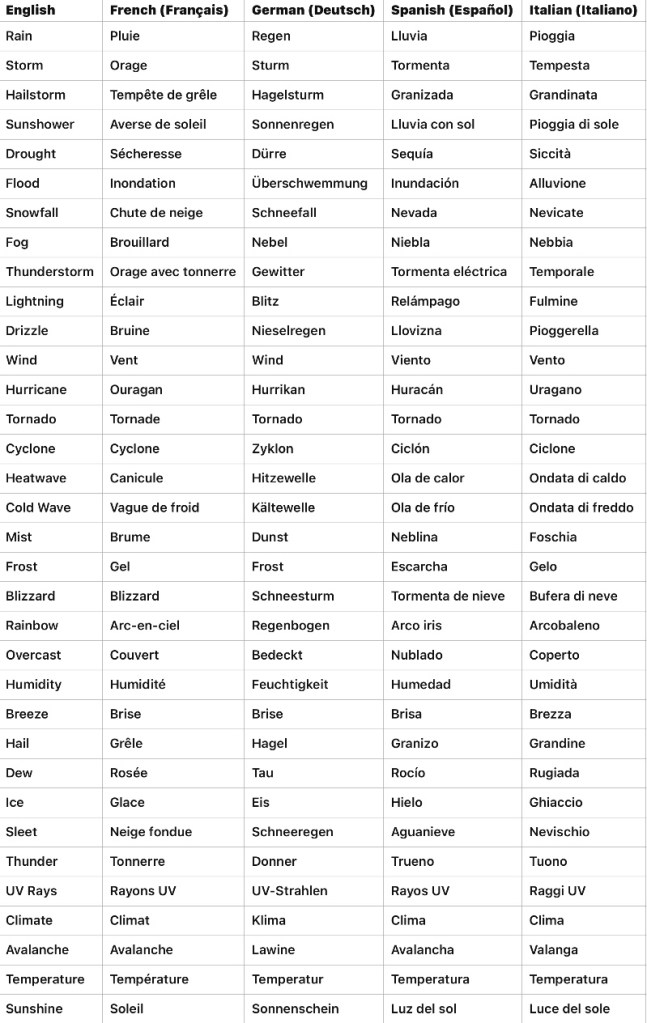
Understanding weather vocabulary in multiple languages can help you communicate better, whether you’re traveling, talking with friends, or improving your language skills. By learning these essential terms, you can confidently discuss weather conditions in French, German, Spanish, and Italian.
Ready to take your language learning to the next level?
Join Lingua Lab today and start mastering new languages with ease!







Leave a comment