

Tenses are the foundation of English grammar, helping us express actions in different time frames. They tell us when an action happened, is happening, or will happen.
1. What Are Tenses?
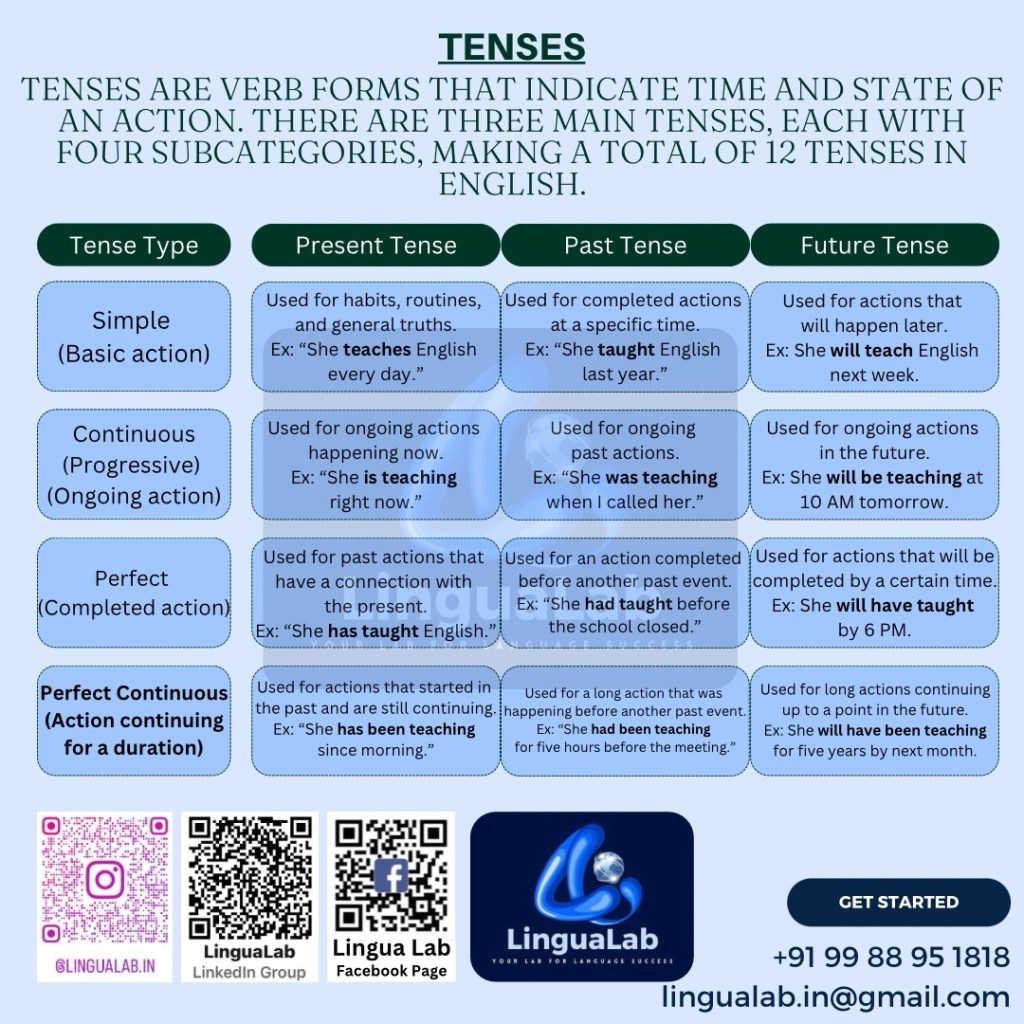
Tenses are verb forms that indicate time and state of an action. There are three main tenses, each with four subcategories, making a total of 12 tenses in English.
Main Tenses:
1. Present Tense – Actions happening now or regularly
2. Past Tense – Actions that happened before now
3. Future Tense – Actions that will happen later
Each of these is further divided into four subtypes:
1. Simple (Basic action)
2. Continuous (Progressive) (Ongoing action)
3. Perfect (Completed action)
4. Perfect Continuous (Action continuing for a duration)
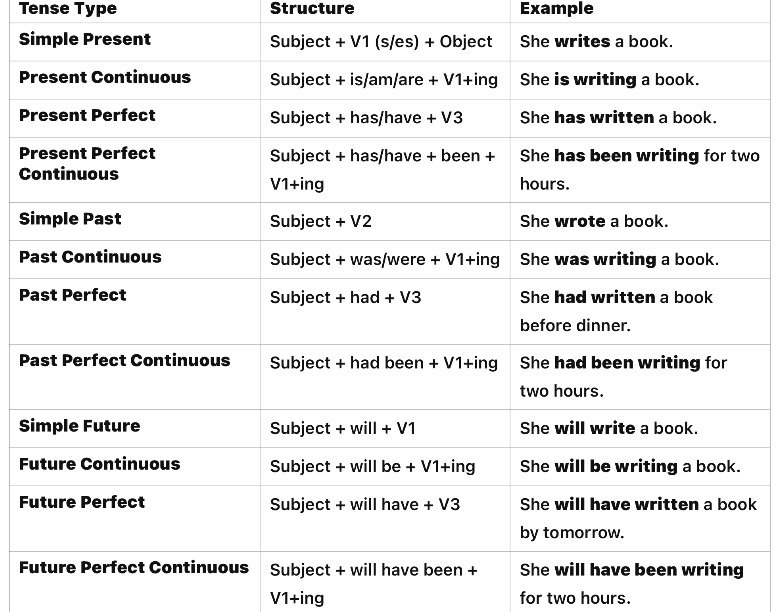
2. Basic Structure of Tenses
3. Explanation of the Three Main Tenses
A. Present Tense (Talks about the present time or general facts)
• Simple Present: Used for habits, routines, and general truths.
• Ex: “She teaches English every day.”
• Present Continuous: Used for ongoing actions happening now.
• Ex: “She is teaching right now.”
• Present Perfect: Used for past actions that have a connection with the present.
• Ex: “She has taught English for five years.”
• Present Perfect Continuous: Used for actions that started in the past and are still continuing.
• Ex: “She has been teaching since morning.”
B. Past Tense (Talks about actions that happened in the past)
• Simple Past: Used for completed actions at a specific time.
• Ex: “She taught English last year.”
• Past Continuous: Used for ongoing past actions.
• Ex: “She was teaching when I called her.”
• Past Perfect: Used for an action completed before another past event.
• Ex: “She had taught before the school closed.”
• Past Perfect Continuous: Used for a long action that was happening before another past event.
• Ex: “She had been teaching for five hours before the meeting.”
C. Future Tense (Talks about actions that will happen in the future)
• Simple Future: Used for actions that will happen later.
• Ex: “She will teach English next week.”
• Future Continuous: Used for ongoing actions in the future.
• Ex: “She will be teaching at 10 AM tomorrow.”
• Future Perfect: Used for actions that will be completed by a certain time.
• Ex: “She will have taught by 6 PM.”
• Future Perfect Continuous: Used for long actions continuing up to a point in the future.
• Ex: “She will have been teaching for five years by next month.”
4. Why Are Tenses Important?
• Help in clear communication
• Avoid grammatical mistakes
• Improve writing and speaking skills
• Help express past, present, and future actions correctly
5. Quick Practice Exercises
Fill in the blanks with the correct tense form:
1. She ______ (study) English for five years. (Present Perfect)
2. We ______ (watch) a movie when she called. (Past Continuous)
3. By next year, he ______ (complete) his graduation. (Future Perfect)
4. I always ______ (wake) up early in the morning. (Simple Present)
5. They ______ (travel) to London next week. (Simple Future)
6. Answer Key:
1. has studied
2. were watching
3. will have completed
4. wake
5. will travel
Achieve Fluency in Spoken English with Lingua Lab
If you want to improve your spoken English and gain confidence in communication, Lingua Lab offers the best online classes to help you achieve your goals.
Why Choose Lingua Lab for Spoken English?
✅ Interactive Live Sessions – Learn through engaging conversations and real-life scenarios.
✅ Personalized Learning – Courses tailored to your level, from beginner to advanced.
✅ Expert Trainers – Highly experienced instructors to guide you.
✅ Best Online Classes by Lingua Lab – Flexible timing to fit your schedule.
✅ Grammar & Vocabulary Boost – Improve sentence structure, pronunciation, and fluency.
✅ Real-World Practice – Role plays, group discussions, and interview preparation.
How Lingua Lab Helps You?
• Fluency & Confidence – Speak English naturally in any situation.
• Accent & Pronunciation – Learn correct sounds and intonation.
• Daily Conversation Skills – Improve speaking ability for work, travel, and socializing.
• Presentation & Public Speaking – Express yourself clearly and effectively.
Start Your Journey with the Best Online Classes by Lingua Lab!
Join Lingua Lab today and take your spoken English skills to the next level!







Leave a comment