
A Comprehensive Guide to Conjunctions and Their Types
In the English language, conjunctions play a crucial role in connecting words, phrases, and clauses to create meaningful and cohesive sentences. Without conjunctions, our sentences would be choppy and disconnected, making communication difficult and unclear. In this blog, we will explore conjunctions in detail, their types, and examples to help you understand how to use them effectively.
What is a Conjunction?
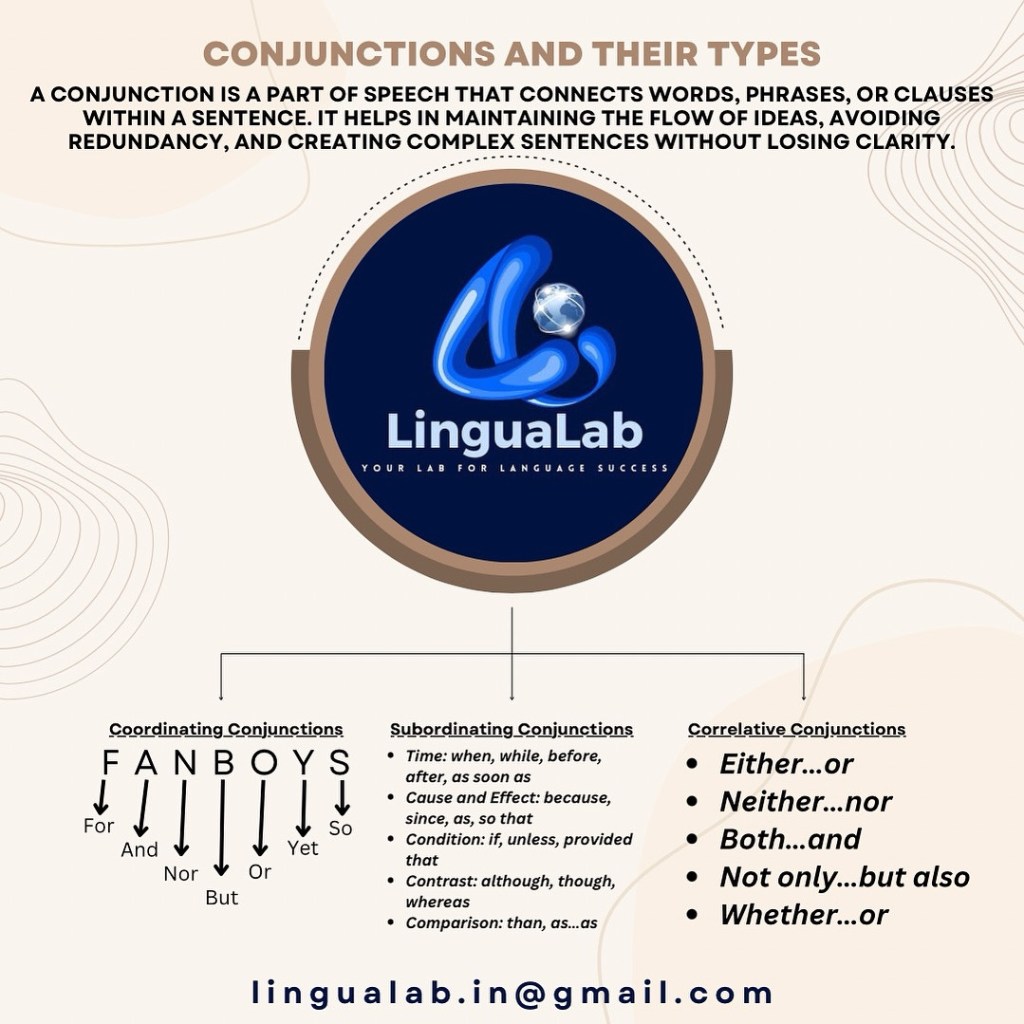
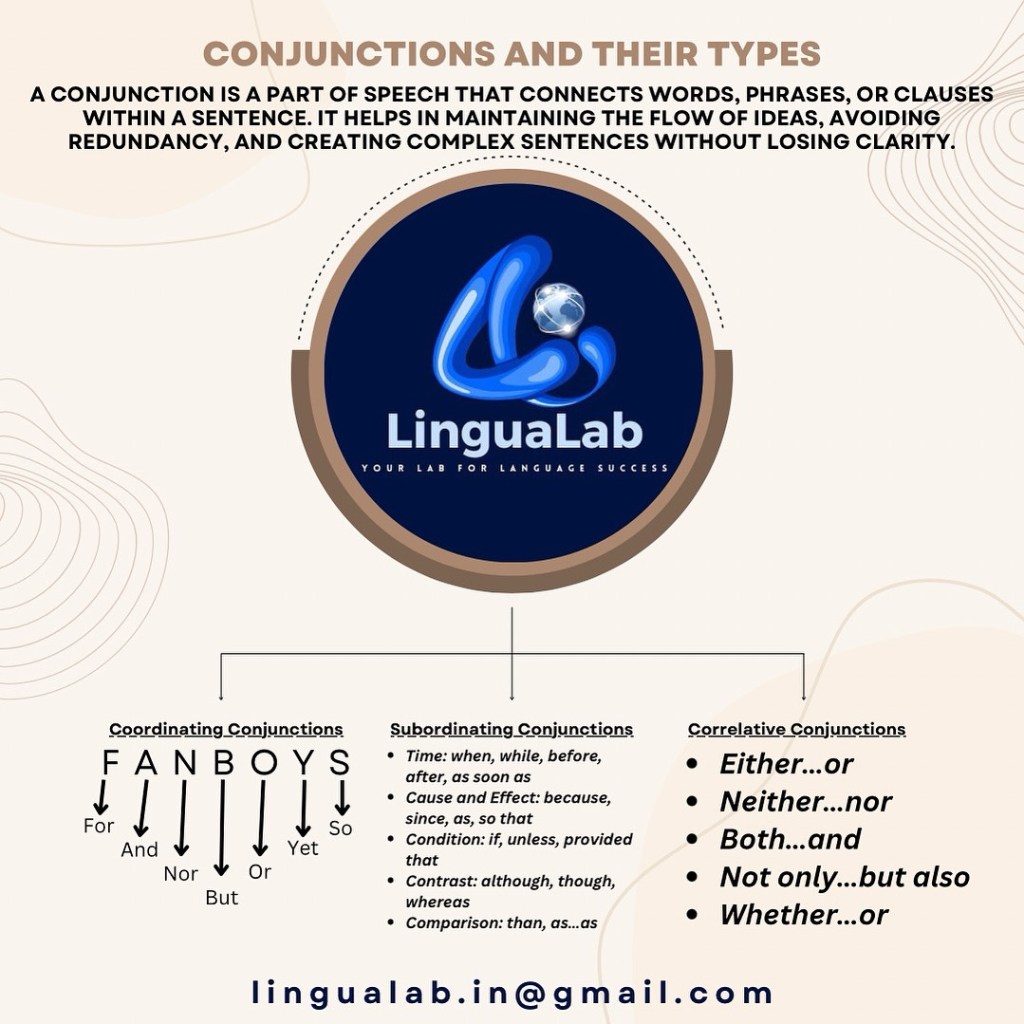
A conjunction is a part of speech that connects words, phrases, or clauses within a sentence. It helps in maintaining the flow of ideas, avoiding redundancy, and creating complex sentences without losing clarity.
Example:
• I wanted to go for a walk, but it started raining.
• She is intelligent and hardworking.
Types of Conjunctions
Conjunctions can be broadly classified into three main types:
1. Coordinating Conjunctions
2. Subordinating Conjunctions
3. Correlative Conjunctions
Let’s take a closer look at each type with explanations and examples.
1. Coordinating Conjunctions
Coordinating conjunctions connect words, phrases, or independent clauses that are of equal importance or grammatical rank in a sentence. They are often remembered using the acronym FANBOYS, which stands for:
• F – For
• A – And
• N – Nor
• B – But
• O – Or
• Y – Yet
• S – So
Examples:
• I like coffee, but my friend prefers tea.
• She studied hard, so she passed the exam.
• You can have cake or ice cream for dessert.
Usage Tip:
Coordinating conjunctions usually require a comma when they join two independent clauses.
Example:
• I was feeling tired, but I continued working.
2. Subordinating Conjunctions
Subordinating conjunctions connect an independent clause with a dependent (subordinate) clause, showing the relationship between them in terms of time, cause, condition, contrast, or comparison.
Common subordinating conjunctions include:
• Time: when, while, before, after, as soon as
• Cause and Effect: because, since, as, so that
• Condition: if, unless, provided that
• Contrast: although, though, whereas
• Comparison: than, as…as
Examples:
• I will call you after I finish my work.
• She couldn’t attend the meeting because she was sick.
• You can go out if you finish your homework.
Usage Tip:
When a subordinate clause comes at the beginning of the sentence, it is usually followed by a comma.
Example:
• Although it was raining, we went for a walk.
3. Correlative Conjunctions
Correlative conjunctions are pairs of conjunctions that work together to link similar elements within a sentence. These conjunctions emphasize the relationship between two elements.
Common correlative conjunctions include:
• Either…or
• Neither…nor
• Both…and
• Not only…but also
• Whether…or
Examples:
• Either you apologize, or I will report this to the manager.
• She is not only talented, but also hardworking.
• Both the students and the teachers enjoyed the trip.
Usage Tip:
Ensure that the elements connected by correlative conjunctions are parallel in structure.
Incorrect:
• She is both intelligent and loves to read.
Correct:
• She both studies hard and excels in sports.
Common Mistakes to Avoid with Conjunctions
1. Overusing conjunctions:
• Avoid using too many conjunctions in a sentence as it can make the sentence unnecessarily long and confusing.
2. Using the wrong conjunction:
• Choose the right conjunction based on the relationship you want to express (e.g., contrast, cause-effect, condition).
3. Incorrect comma placement:
• Use commas correctly when joining independent clauses with coordinating conjunctions.
4. Lack of parallel structure:
• Ensure elements connected by correlative conjunctions are grammatically parallel.
Practice Questions
Test your understanding of conjunctions by completing the sentences below:
1. I wanted to go to the party, _____ I had too much work to do.
2. She will succeed _____ she works hard.
3. You can _____ stay here _____ come with us.
4. He enjoys reading novels _____ watching movies.
5. _____ it was late, he continued working on his project.
(Answers: but, if, either…or, and, Although)
Conjunctions are essential in constructing sentences that are clear, concise, and connected. Whether you are writing essays, reports, or casual messages, using the right conjunctions will enhance your communication skills.
Practice using conjunctions in your daily writing, and soon, they will become second nature to you!
Stay tuned for more grammar tips and lessons from Lingua Lab.







Leave a comment