

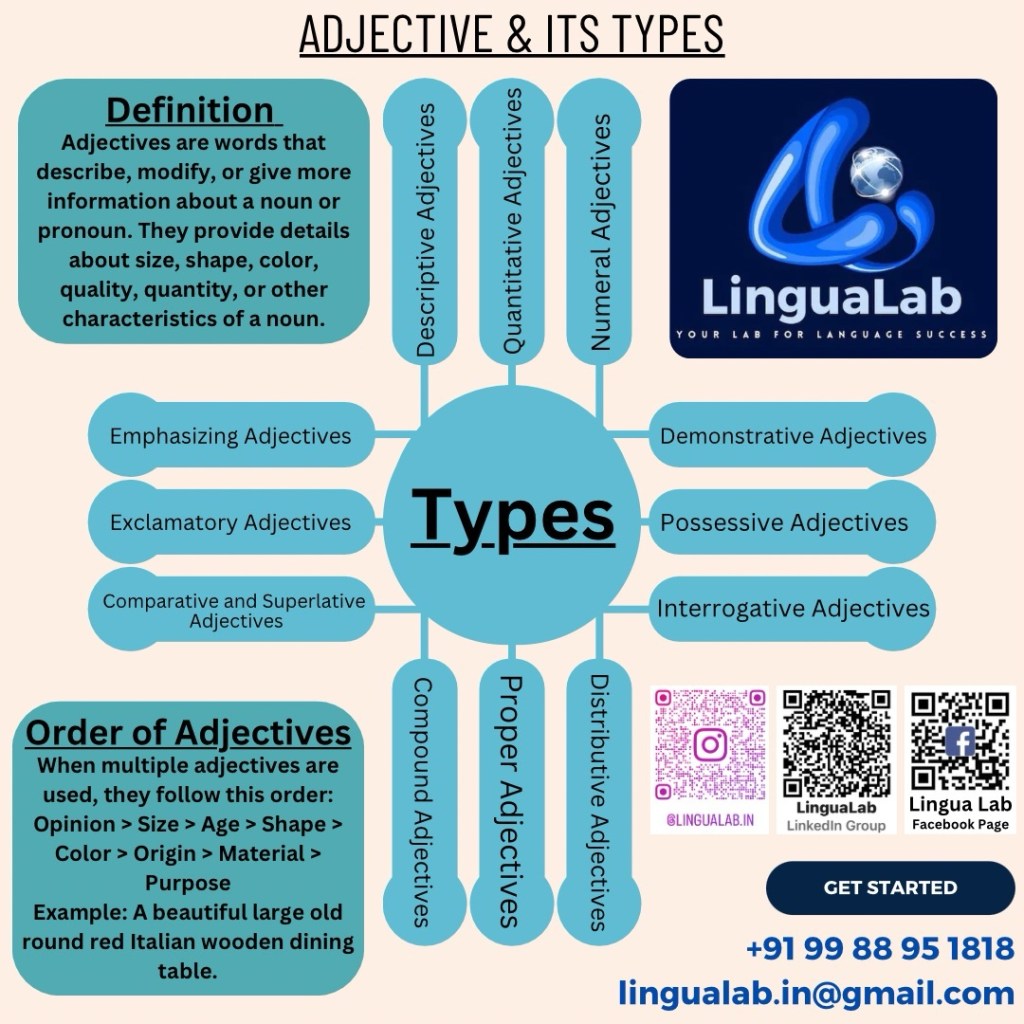
ADJECTIVES– Definition
Adjectives are words that describe, modify, or give more information about a noun or pronoun. They provide details about size, shape, color, quality, quantity, or other characteristics of a noun. Understanding adjectives is essential for improving sentence structure and communication clarity.
Types of Adjectives
1. Descriptive Adjectives
These describe the quality, state, or characteristic of a noun.
Examples: beautiful, large, intelligent, happy, old
• Sentence: She wore a beautiful dress.
2. Quantitative Adjectives
These indicate the quantity of a noun (how much or how many).
Examples: some, many, few, several, little, enough
• Sentence: He ate some rice.
3. Numeral Adjectives
These express numbers or the order of things.
Subcategories:
• Cardinal: one, two, three (show count)
• Sentence: She has two dogs.
• Ordinal: first, second, third (show order)
• Sentence: He came first in the race.
• Multiplicative: single, double, triple (show multiplication)
• Sentence: They built a double-layered fence.
4. Demonstrative Adjectives
These point out specific nouns.
Examples: this, that, these, those
• Sentence: This book is mine.
5. Possessive Adjectives
These indicate possession or ownership.
Examples: my, your, his, her, its, our, their
• Sentence: Their house is very big.
6. Interrogative Adjectives
These are used to ask questions and are followed by a noun.
Examples: which, what, whose
• Sentence: Whose bag is this?
7. Distributive Adjectives
These refer to individual elements of a group.
Examples: each, every, either, neither
• Sentence: Each student must bring their own book.
8. Proper Adjectives
These are derived from proper nouns and are always capitalized.
Examples: Indian, American, Shakespearean
• Sentence: I love Italian cuisine.
9. Compound Adjectives
These are formed by combining two or more words, often joined by a hyphen.
Examples: well-known, three-day, high-quality
• Sentence: She is a well-known author.
10. Emphasizing Adjectives
These emphasize the importance of a noun.
Examples: own, very
• Sentence: This is my own house.
11. Exclamatory Adjectives
These are used to express strong emotions or exclamations.
Examples: what, such
• Sentence: What a beautiful painting!
12. Comparative and Superlative Adjectives
These are used to compare two or more nouns.
• Positive: Describes a single noun (e.g., tall)
• Comparative: Compares two nouns (e.g., taller)
• Superlative: Compares three or more nouns (e.g., tallest)
• Sentence: He is taller than his brother.
Order of Adjectives
When multiple adjectives are used, they follow this order:
Opinion > Size > Age > Shape > Color > Origin > Material > Purpose
Example: A beautiful large old round red Italian wooden dining table.
Understanding and using adjectives effectively enhances both writing and speaking, making communication clearer and more engaging.







Leave a comment