
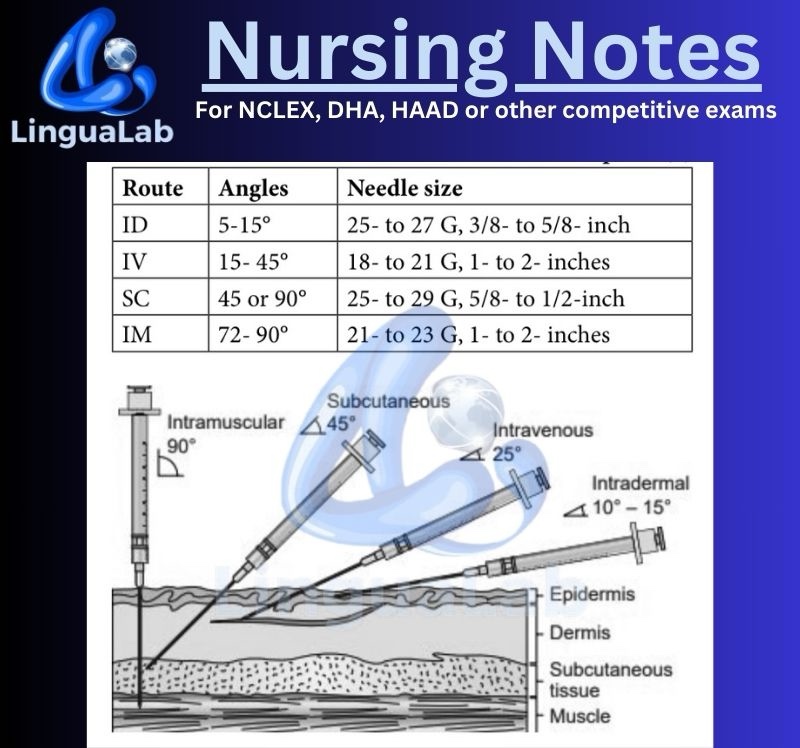
Administering injections is a fundamental skill for nurses, requiring a thorough understanding of needle sizes, injection routes, angles, and the corresponding skin layers involved. Choosing the correct needle size and injection technique ensures effective medication delivery, minimizes patient discomfort, and prevents complications.
Understanding Needle Sizes
Needle sizes are classified based on gauge (G) and length (inches/mm):
• Gauge (G): Refers to the diameter of the needle; the higher the gauge, the thinner the needle.
• Length: Varies based on the injection type and site.
Common needle sizes used in nursing practice include:
Injection Routes, Angles, and Skin Layers
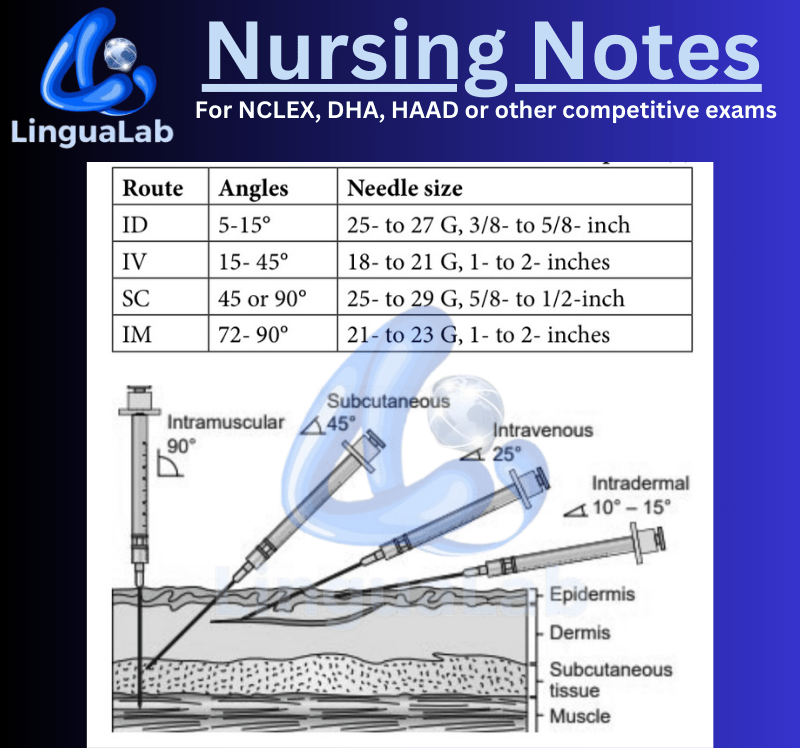
The selection of an injection route depends on the type of medication, absorption rate required, and the patient’s condition. The three primary injection routes are:
1. Intradermal (ID) Injections
• Route: Delivered into the dermis (just below the epidermis).
• Angle: 10° to 15°
• Common Sites: Forearm, upper back
• Purpose: Allergy tests, TB testing
• Needle Size: 26-30 G, 1/4 to 1/2 inch
Technique: Insert the needle with the bevel facing up, ensuring it goes into the dermis layer without penetrating deeper tissues.
2. Subcutaneous (SC) Injections
• Route: Delivered into the subcutaneous tissue (fatty layer beneath the dermis).
• Angle: 45° (for most cases) or 90° (for shorter needles)
• Common Sites: Abdomen, thigh, upper arm
• Purpose: Insulin, heparin
• Needle Size: 25-30 G, 3/8 to 5/8 inch
Technique: Pinch the skin to separate the subcutaneous layer and insert the needle at the correct angle.
3. Intramuscular (IM) Injections
• Route: Delivered into the muscle layer beneath the subcutaneous tissue.
• Angle: 90°
• Common Sites: Deltoid, vastus lateralis, gluteus medius
• Purpose: Vaccines, antibiotics, hormones
• Needle Size: 18-25 G, 1 to 1.5 inches
Technique: Stretch the skin taut and insert the needle quickly at a right angle to reach the muscle.
Key Considerations for Safe Injections
1. Choose the appropriate needle size based on the patient’s age, weight, and injection site.
2. Always follow aseptic techniques to prevent infection.
3. Rotate injection sites to avoid tissue damage and lipodystrophy.
4. Dispose of needles safely in designated sharps containers.
Multiple-Choice Questions (MCQs)
1. What is the typical angle for intramuscular (IM) injections?
a) 10°
b) 45°
c) 90°
d) 15°
2. Which layer of the skin do subcutaneous injections target?
a) Epidermis
b) Dermis
c) Subcutaneous tissue
d) Muscle
3. What is the most commonly used site for intradermal injections?
a) Abdomen
b) Forearm
c) Deltoid
d) Thigh
4. Which needle gauge is appropriate for intramuscular injections?
a) 18-25 G
b) 26-30 G
c) 31-34 G
d) 10-15 G
5. Which of the following injection types requires the longest needle length?
a) Intramuscular
b) Subcutaneous
c) Intradermal
d) Intravenous
Answers to MCQs
1. c) 90°
2. c) Subcutaneous tissue
3. b) Forearm
4. a) 18-25 G
5. a) Intramuscular
By mastering the proper techniques and understanding the differences in needle sizes, routes, and angles, nurses can ensure safe and effective medication administration, ultimately improving patient care.







Leave a comment