
A VERB
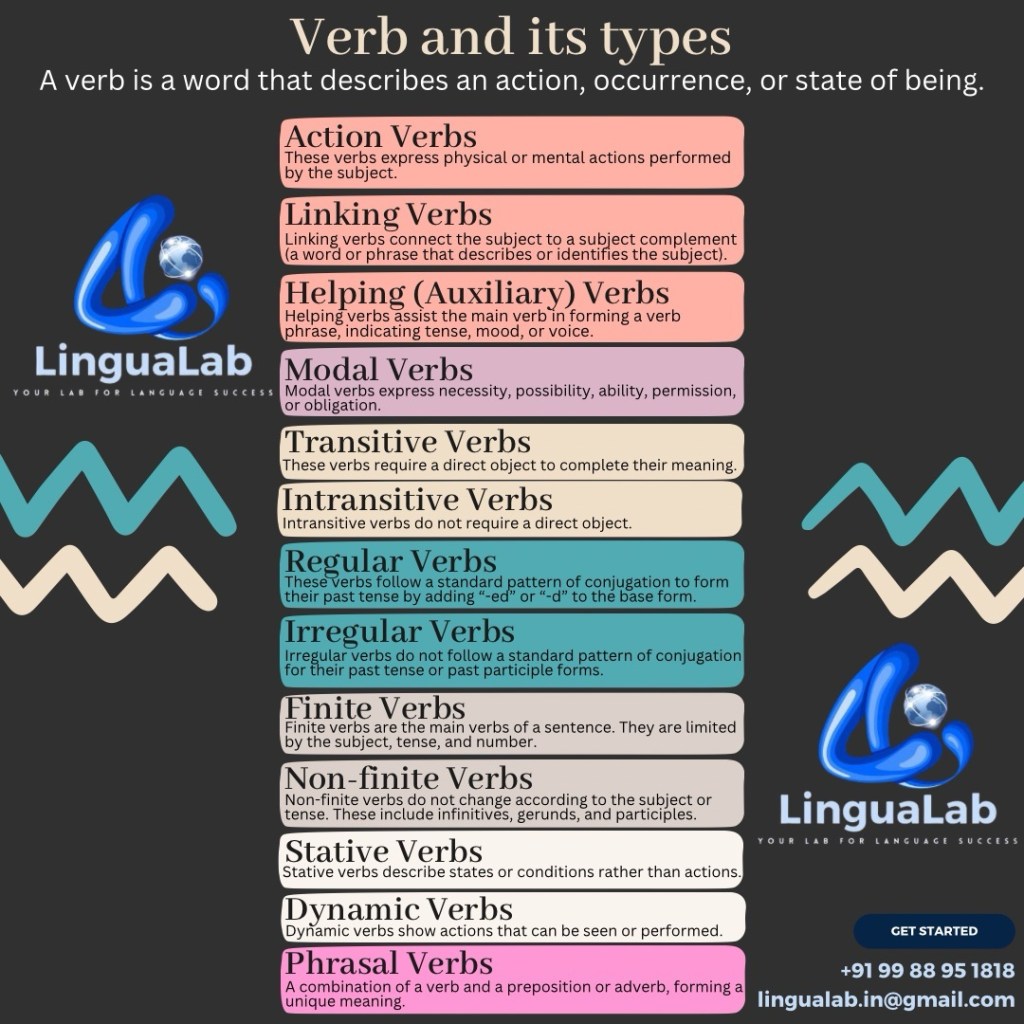
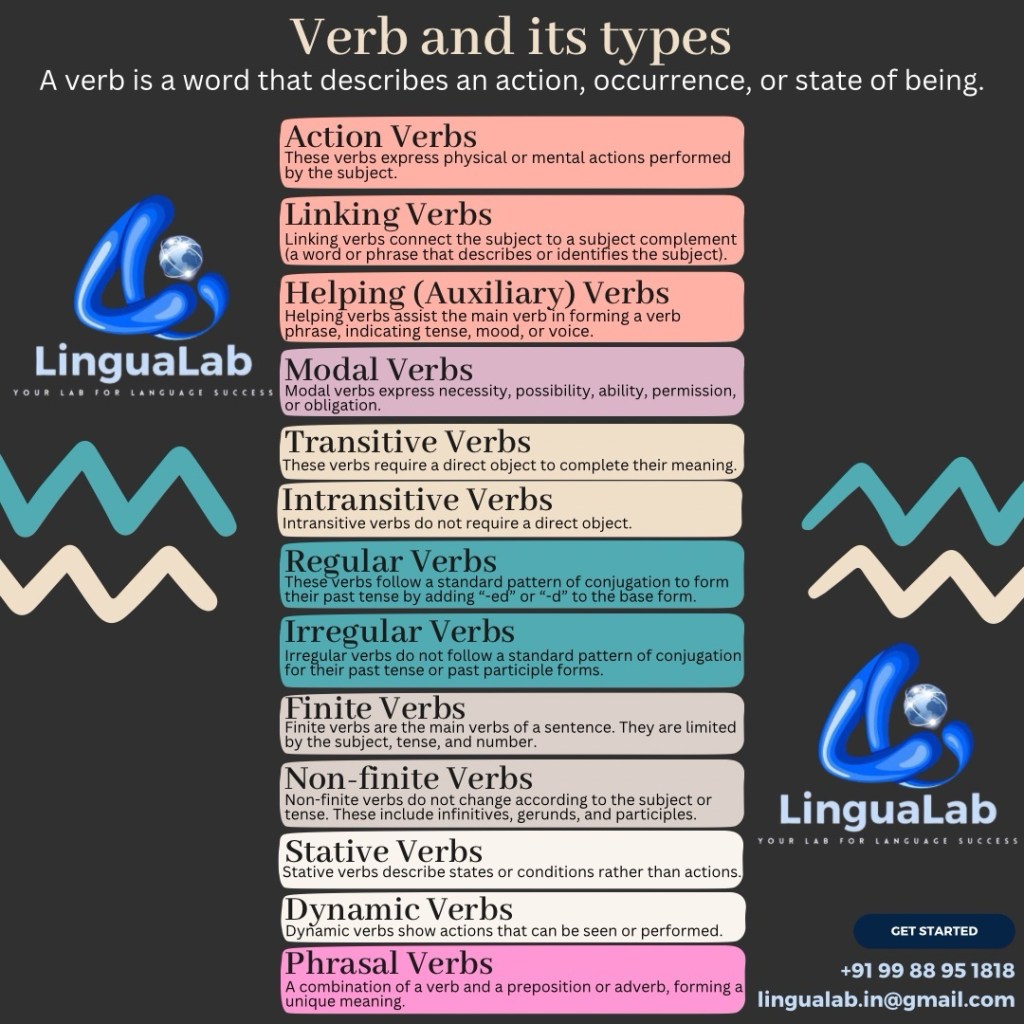
A verb is a word that describes an action, occurrence, or state of being. It is one of the most crucial parts of speech in English, as it forms the backbone of a sentence and helps convey what the subject is doing or experiencing.
Types of Verbs
1. Action Verbs
These verbs express physical or mental actions performed by the subject.
• Physical Action: run, jump, write, dance
• Mental Action: think, believe, understand, imagine
Examples:
• She runs every morning.
• I believe in honesty.
2. Linking Verbs
Linking verbs connect the subject to a subject complement (a word or phrase that describes or identifies the subject). They do not show action but indicate a state of being or condition.
• Common linking verbs: is, am, are, was, were, seem, appear, become, feel, grow, look, smell, taste
Examples:
• The sky is blue.
• He feels tired after the long day.
3. Helping (Auxiliary) Verbs
Helping verbs assist the main verb in forming a verb phrase, indicating tense, mood, or voice.
• Common helping verbs: is, am, are, was, were, has, have, had, will, shall, can, could, would, should, might, may
Examples:
• She is going to the park.
• They have completed their homework.
4. Modal Verbs
Modal verbs express necessity, possibility, ability, permission, or obligation. They are a subset of auxiliary verbs.
• Common modal verbs: can, could, may, might, must, shall, should, will, would
Examples:
• You must finish the project by tomorrow.
• We might visit the museum this weekend.
5. Transitive Verbs
Transitive verbs require a direct object to complete their meaning.
Examples:
• She wrote a letter.
• They bought a new car.
6. Intransitive Verbs
Intransitive verbs do not require a direct object.
Examples:
• He slept peacefully.
• The baby cried loudly.
7. Regular Verbs
These verbs follow a standard pattern of conjugation to form their past tense by adding “-ed” or “-d” to the base form.
Examples:
• walk → walked
• play → played
8. Irregular Verbs
Irregular verbs do not follow a standard pattern of conjugation for their past tense or past participle forms.
Examples:
• go → went → gone
• eat → ate → eaten
9. Finite Verbs
Finite verbs are the main verbs of a sentence. They are limited by the subject, tense, and number.
Examples:
• She reads books daily.
• They were running late.
10. Non-finite Verbs
Non-finite verbs do not change according to the subject or tense. These include infinitives, gerunds, and participles.
• Infinitive: to read, to write (e.g., I like to read.)
• Gerund: reading, writing (e.g., Reading is fun.)
• Participle: written, writing (e.g., The written letter was clear.)
11. Stative Verbs
Stative verbs describe states or conditions rather than actions.
Examples:
• She owns a car.
• I love chocolate.
12. Dynamic Verbs
Dynamic verbs show actions that can be seen or performed.
Examples:
• He runs every morning.
• They are building a house.
13. Phrasal Verbs
A combination of a verb and a preposition or adverb, forming a unique meaning.
Examples:
• She gave up smoking.
• They ran into an old friend.
Understanding verbs and their types is essential for constructing grammatically correct and meaningful sentences. They form the core of communication by expressing actions, conditions, and states of being.







Leave a comment